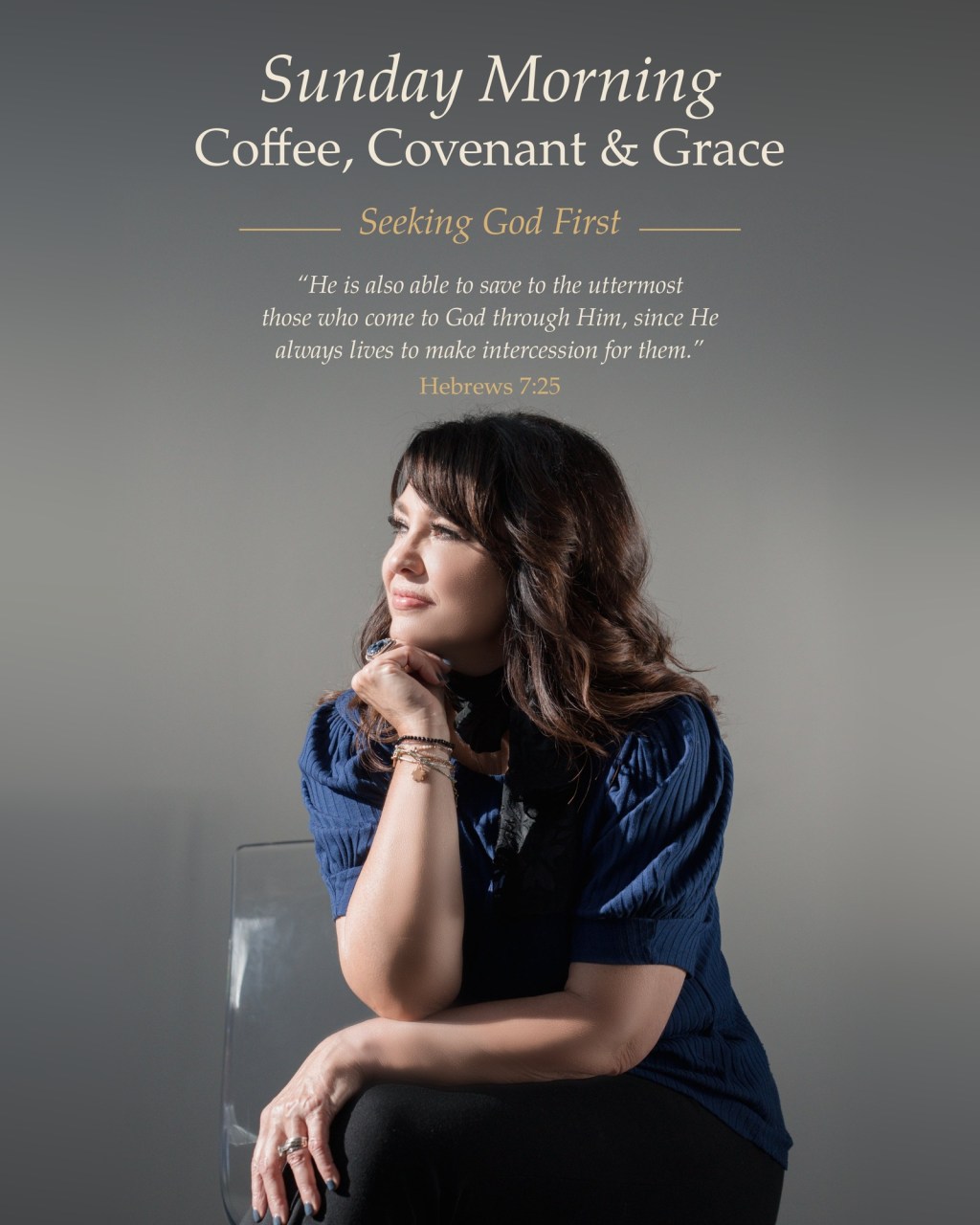
Sunday Morning Coffee, Covenant & Grace
Series Verse — Matthew 6:33 (NKJV)
“But seek first the kingdom of God and His righteousness, and all these things shall be added to you.”
This Week’s Scripture Focus — Hebrews 7:24–25 (NKJV)
“But He, because He continues forever, has an unchangeable priesthood. Therefore He is also able to save to the uttermost those who come to God through Him, since He always lives to make intercession for them.”
Welcome to My Quiet Corner
Most of you know this about me — I heal, dream, live, and breathe through writing. It’s how God and I talk. It’s how I work through the deep places of life.
So pull up a chair. Bring your coffee. I’m so glad you’re here.
Over the next several Sundays, I’d love for you to sit with me as we walk slowly through Jesus’ words in Matthew 6:33. One promise, one week at a time.
And isn’t it something how God works?
Have you ever picked up a book, thinking you knew exactly what you were going to find within its pages, only to discover that God had something entirely different waiting for you?
That’s how this journey of intentionally seeking God first began for me.
It started with a book. A 40-day prayer devotional that I began reading because I had committed to praying for someone in my family. My heart was focused on that person, the circumstances surrounding their life, and bringing their needs faithfully before God.
But somewhere along those 40 days, something began happening in my own heart.
What started as a commitment to pray for someone else became an invitation to spend more intentional time with God. I began looking forward to those moments with Him, opening His Word, lingering a little longer over Scripture, and discovering that the more time I spent seeking Him, the more I wanted to know Him.
We come to Him carrying someone else’s burdens, and somewhere along the way, He begins doing a beautiful work in us, too.
Forty short days. That’s all it took to begin changing the way I approached my mornings, my prayers, and even the ordinary moments of my day. What began as a commitment has been growing into something I pray will become a lifelong habit, one that won’t quietly disappear when life becomes busy again.
And that brings me to this morning.
Here I sit, coffee nearby, Bible open, studying for my Bible class this coming week. We’ve been spending time in Romans, and I cannot begin to tell you how many things in Paul’s words have challenged me, encouraged me, and caused me to look more closely at my own walk with Christ.
You know those moments when you’ve read a passage before, perhaps even many times, but suddenly the words seem to leap right off the page?
That’s what happened to me this morning.
A Question That Opened My Heart
As I sat studying Romans, I came across a question that caused me to stop and think a little longer.
What does God’s gift of reconciliation reveal about Him?
It seemed simple enough when I first read it, but the longer I sat with it, the more I realized how much was wrapped up in those few words.
I found myself reading Romans 5:9–11 again. Through the blood of Jesus, we are made right with God. Through His death, we are brought back home to God. And through His risen life, we have the assurance of salvation.
And I began thinking about the word reconciliation.
We understand reconciliation in our earthly relationships, don’t we? We know what it feels like when something comes between us and someone we love. We know the heartache of broken trust, the distance that grows when words are spoken or actions are taken that cannot simply be undone.
Maybe you’ve experienced the heartbreak of a family relationship that isn’t what it once was. Maybe you’ve struggled to forgive someone who wounded you deeply. Or perhaps you’ve been the one who needed forgiveness, wishing you could go back and change something you said or did.
Most of us know what a broken relationship feels like.
And isn’t it true that sometimes the hardest part of reconciliation is simply being the first one to reach out?
But as I read Paul’s words, something extraordinary began to settle into my heart.
God was the One who reached toward us first.
“For if when we were enemies we were reconciled to God through the death of His Son, much more, having been reconciled, we shall be saved by His life.” — Romans 5:10 (NKJV)
Not when we finally got everything right. Not when we became worthy of His love. Not when we had done enough good things to somehow make up for our mistakes.
While we were still His enemies.
Take a slow sip with me and let that settle for a moment.
The very One we had sinned against was the One who made a way for us to be forgiven and brought near.
And suddenly, my thoughts traveled all the way back to the Garden of Eden.
The Beauty of a Garden and the Heart of Its Creator
Come with me for just a moment, all the way back to the beginning, to a place so magnificent that I wonder whether our earthly imaginations can even begin to comprehend its beauty.
Before sorrow had ever touched a human heart, before sickness had weakened a body, before a single tear had fallen because of grief or disappointment, there was a garden. Not a garden planted by human hands, but a paradise lovingly prepared by the Creator of heaven and earth Himself.
Can you imagine what it must have been like to stand in the middle of God’s perfect creation? To breathe air untouched by pollution, to feel the warmth of the sun, to hear the gentle movement of water flowing through a landscape filled with life?
I imagine trees stretching toward the heavens, their branches heavy with fruit, flowers displaying colors more magnificent than anything we’ve ever seen, and the sounds of creation filling the air with a harmony that only God Himself could have composed.
Genesis 2:9 tells us that God caused trees to grow that were both pleasant to the sight and good for food. I find that detail so beautiful, because it reminds me that God didn’t simply create a world where Adam and Eve could survive. He created a place where they could flourish, where beauty and abundance surrounded them, and where everything they needed had already been lovingly provided.
There was no fear of tomorrow, no painful memory of yesterday, no striving to earn enough, accomplish enough, or become enough. Adam had been given the meaningful responsibility of tending and keeping the garden (Genesis 2:15), but work had not yet become burdened by the hardship that would follow the fall.
And when God saw that it was not good for man to be alone, He created Eve, giving Adam a companion with whom to share the wonder of life.
Yet as breathtaking as Eden must have been, I believe its greatest treasure was not found in the flowers, the rivers, the trees, or even the extraordinary beauty of creation itself.
Its greatest treasure was the relationship Adam and Eve enjoyed with their Creator.
The God who spoke the stars into existence, who set the boundaries of the oceans and formed the mountains, had created human beings in His own image and welcomed them into a relationship with Himself.
Genesis 2:25 tells us that Adam and Eve were naked and unashamed. They had no reason to hide, no need to pretend, and no burden of wondering whether they were loved or whether their needs would be met.
What would it feel like to begin each morning with a heart completely at peace, knowing that nothing stood between you and your Creator?
Genesis 3:8 gives us a glimpse of the Lord God walking in the garden. Scripture doesn’t tell us the details of Adam and Eve’s daily conversations with Him, but that moment invites us to consider the extraordinary nearness of the God who made them.
And as I sit here thinking about that garden, something stirs deeply in my heart.
That same God longs to be close to you and me.
Not simply to attend a worship service once a week, not merely to serve Him through our good works, and certainly not only to call upon Him when life becomes more than we can bear.
He invites us into a living relationship, one where His Word shapes our thoughts, His presence steadies our hearts, and His love becomes the foundation upon which we build our lives.
James 4:8 reminds us to draw near to God, with the promise that He will draw near to us.
When Another Voice Entered the Garden
There, in the midst of all that beauty, all that provision, and all that closeness with God, another voice entered the garden.
A voice that questioned God’s goodness, challenged His Word, and suggested that perhaps the Creator was withholding something better.
And Adam and Eve, surrounded by everything they could ever have needed, chose to believe that other voice.
And I wonder, as I sit here with my Bible open and my coffee growing cold, are we really so different today?
Most of us who know Christ would never intentionally say that we don’t believe God’s Word. We would tell you we love Him, trust Him, and believe His promises.
But if we’re willing to look honestly at our everyday lives, how often do our choices tell a different story?
We know His Word brings wisdom, yet we reach for everyone else’s opinions before opening our Bibles. We know He invites us to bring our burdens to Him, yet we spend hours worrying about things we haven’t spent five minutes praying over.
And sometimes, we simply don’t open our Bibles at all.
Not because we’ve stopped loving God, but because life gets busy.
There are children to raise, grandchildren to love, businesses to run, bills to pay, meals to prepare, appointments to keep, and a hundred little things demanding our attention before our feet even touch the floor in the morning.
And then there are the distractions we choose. One more scroll through Facebook, one more television show, one more thing crossed off our never-ending to-do list.
Before we know it, the day is gone. The Bible is still sitting where we left it, and the One who gave us the very breath we used to accomplish everything that day has received so little of our attention.
Oh, how easily we can become busy living the life God has given us while forgetting to spend time with the God who gave us life.
I write that with tenderness, because I recognize myself in those words.
How many mornings have I allowed my responsibilities to speak before I’ve listened to His promises? How many times have I asked God for direction while neglecting to open the very Word through which He teaches and guides me?
Sometimes we don’t even realize we’ve begun listening to another voice.
The voice of fear tells us everything is falling apart. The voice of comparison tells us we’re falling behind. The voice of disappointment tells us things will never change.
And the voice of the world tells us that if we just work harder, accomplish more, earn more, or somehow get everything under control, we’ll finally find peace.
And all the while, God’s Word is inviting us to something entirely different.
“Be still, and know that I am God.” — Psalm 46:10 (NKJV)
Not be still when everything is finished. Not seek Him when our calendars are empty. Not come to Him after we’ve exhausted every other possibility.
Just come.
That little word in Matthew 6:33, first, carries so much meaning, because what we seek first often reveals what we’re trusting most.
“Where Are You?”
Adam and Eve listened to another voice. They disobeyed the very One who had given them life, and suddenly everything changed.
Shame entered where innocence had lived. Fear replaced closeness. And the two people who had once lived openly before their Creator found themselves hiding among the trees.
But here is the part of that story I cannot stop thinking about.
God already knew.
He knew what they had done. He knew the command they had broken. He knew the consequences that would follow, not only for them but for every generation that would come after them.
And still, He came into the garden.
He called to Adam.
“Where are you?” — Genesis 3:9 (NKJV)
Not because God had lost sight of him.
But because Adam had lost his way.
And I wonder whether that same question might be stirring in your heart this morning, the way it has been stirring in mine.
Where are you?
Not where are you sitting, or where are you going today, but where are you in your relationship with Me?
When was the last time you opened My Word simply because you wanted to know Me better? When was the last time you sat in My presence without asking for anything, without rushing to the next responsibility, without feeling the need to fill the silence?
Perhaps you’ve been hiding behind disappointment. Perhaps guilt has convinced you that you’ve wandered too far. Perhaps life has become so busy that you haven’t even realized how long it’s been since you truly sat with Him.
If that’s you this morning, there’s no shame in this quiet corner. Only an invitation.
The God who came looking for Adam is still the God who lovingly calls us back into relationship with Himself.
Even in Judgment, There Was Mercy
There is another detail in Genesis that deserves our attention.
After Adam and Eve sinned, they attempted to cover themselves with fig leaves.
But their own efforts could not undo what had happened.
Genesis 3:21 tells us that God made tunics of skin for Adam and Eve and clothed them.
Think about that.
The very God they had disobeyed provided what they could not adequately provide for themselves.
Can we stay right here for a moment? Because I don’t want us to rush past this.
Picture it with me.
The garden is quiet now. The fruit has been eaten. The hiding is over. Two frightened people stand before their Creator in fig leaves that are already beginning to wilt.
And God kneels down to make them something better.
Scripture doesn’t tell us how He did it. But I can’t help picturing the Creator of the universe bending low, His hands working slowly, fitting a garment to the shoulders He had formed from the dust. Measuring the arms He had shaped. Making sure it would keep them warm in a world that was about to grow cold.
Every stitch, an act of love.
And every stitch, I imagine, an ache.
Because He knew.
He knew they had believed a lie about Him. He knew they were about to walk out of the only home they had ever known, and that the way back would be closed behind them (Genesis 3:23–24). He knew the thorns that would come, the sweat, the sorrow. He knew that one of the sons they had not yet held in their arms would one day rise up against his own brother (Genesis 4:8).
And He knew what it would cost to bring them home.
Genesis 6:6 tells us that the Lord was grieved in His heart. Our God is not distant or unmoved. He feels the weight of our wandering.
I know a little of that ache.
Our family has walked through the loss of a grandchild. It changed all of us. It hurt more deeply than anyone outside of it could ever fully understand.
And as a grandmother, there was a second grief I wasn’t prepared for: watching my own children carry a pain I could not take from them. I would have carried every ounce of it if I could. I couldn’t. All I could do was love them, pray, and stay close.
I don’t share that so you’ll feel sorry for us. I share it because I suspect you have your own version of that moment.
Maybe you’ve watched a child walk away from everything you taught them. Maybe you’ve sat beside someone you love in a hospital room, or in a quiet kitchen at two in the morning, wishing with everything in you that you could take their place. Maybe you’ve stood beside a grave of your own.
If so, you know that helpless, aching kind of love. The kind that longs to cover and protect, and can’t always.
I wonder if that is a small glimpse of what God felt as He stitched those garments.
And still, my love is only a shadow of His.
Because our Heavenly Father didn’t simply sit up waiting for us to come home.
He came looking. He covered us. And then He gave the one thing no parent could ever bear to give.
His own Son.
Sit with that for a moment. Let it sink all the way in.
Those garments of skin point us toward a sobering reality. An animal’s life would ordinarily have been taken to provide them. Although Genesis doesn’t explicitly describe the shedding of blood in that moment, many Christians have long understood it as a beautiful foreshadowing of the sacrifice that would one day come through Jesus Christ.
Sin had brought death into the human story.
And even there, at the beginning of humanity’s brokenness, we see a glimpse of God’s mercy.
The covering Adam and Eve needed was provided by God.
And centuries later, the covering we would need for our sins would also come from God.
Only this time, the sacrifice would not be an animal.
It would be His Son.
While We Were Still Sinners
Romans 5:8 (NKJV) says:
“But God demonstrates His own love toward us, in that while we were still sinners, Christ died for us.”
Read those words again.
While we were still sinners.
Not after we had cleaned ourselves up.
Not after we had learned to pray beautifully, memorize enough Scripture, attend enough church services, or become the people we thought God wanted us to be.
While we were still sinners.
I don’t know about you, but that truth humbles me.
Because I know myself.
I know there have been moments when my faith has been strong and moments when fear has spoken louder than truth. Times when I have trusted God completely and times when I’ve tried to take control of things He never asked me to carry.
I know what it means to need grace.
And the older I grow in my relationship with Christ, the more I understand that His love was never something I could earn.
It was something He chose to give.
And He gave it knowing every mistake I would ever make.
Every doubt. Every failure. Every moment of disobedience.
He knew it all, and He loved us still.
The Gift of Reconciliation
Now let’s return to that question from my Bible study.
What does God’s gift of reconciliation reveal about Him?
After walking through the beauty of Eden, the heartbreak of the fall, and the mercy of a God who came looking for us, I think we begin to see the answer a little more clearly.
It reveals His holiness, because sin could not simply be ignored. It reveals His justice, because the consequences of sin mattered. But it also reveals a love and mercy so extraordinary that He willingly provided the sacrifice we could never provide for ourselves.
In 2 Corinthians 5:18–19, Paul explains that God brought us back to Himself through Jesus Christ.
The separation that began in the garden did not have to be the end of our story.
God made a way for us to come home.
Not through our goodness, but through Christ’s righteousness.
Not through our ability to make ourselves worthy, but through His willingness to bear what we could not.
Jesus suffered. He was rejected. He endured unimaginable pain and willingly gave His life.
And through faith in Him, we are joined to Christ.
Romans 6:5 teaches that those united with Him in the likeness of His death will also share in the likeness of His resurrection.
And here is where the promise becomes almost too wonderful to comprehend.
Jesus did not remain in the grave.
He rose.
Not merely as a memory, a spiritual idea, or a comforting story passed down through generations.
He rose bodily, truly alive.
In Luke 24:39, the resurrected Jesus invited His disciples to look at His hands and feet and recognize that it was truly Him.
The One who had been crucified was standing before them.
Alive.
And because He lives, those who belong to Him have the promise of resurrection life.
As Jesus said in John 14:19:
“Because I live, you will live also.” (NKJV)
Can we sit with that for a moment?
From the Pit to the Glory That Awaits
Death is not the end of the story for those who are in Christ.
Not for the mother who has buried a child.
Not for the husband or wife who has stood beside a grave wondering how to take another step.
Not for the person facing a frightening diagnosis.
Not for those of us who have watched someone we love take their final breath and wished with everything in us for one more conversation.
The pain of those moments is real.
The grief is real.
But so is the resurrection.
Now, I want to be careful here, because sometimes Christians speak about faith as though believing in Jesus means life will somehow become easy.
But Jesus never promised that.
We live in a fallen world. A world where the enemy seeks to deceive and destroy, where sickness comes, relationships fracture, dreams fall apart, and people we love sometimes leave us far sooner than we ever imagined.
There are disappointments that shake us.
Grief that changes us.
Prayers that seem to go unanswered.
Seasons when we are so exhausted that even getting out of bed feels like an act of courage.
And there are moments when the pit seems so deep that we cannot imagine seeing daylight again.
Maybe you’re sitting in one of those moments right now, holding your coffee with both hands because it’s the only steady thing you have this morning. If so, I’m right here with you.
Because this is what I am learning.
Seeking God first doesn’t mean pretending the pit isn’t there. It means remembering that the pit is not where our hope ends.
It means lifting our eyes toward the One who has already overcome the grave.
Colossians 3:2 (NKJV) tells us:
“Set your mind on things above, not on things on the earth.”
And oh, look at what is waiting above.
Revelation 21:1–4 tells us of a new heaven and a new earth, where God will dwell with His people and wipe away every tear from their eyes. Death will be no more, nor will there be sorrow, crying, or pain, because the former things will have passed away.
Can you imagine?
A world where we will never again stand beside a hospital bed wondering what tomorrow will bring. Where no family will gather around a grave with hearts shattered by loss.
No devastating phone calls. No painful diagnoses. No quiet nights spent longing for someone whose absence has changed everything.
Revelation 22:1–5 gives us a breathtaking glimpse of that promised future: the river of the water of life, clear as crystal, flowing from the throne of God and of the Lamb, and the tree of life bearing its fruit.
There will be no more curse.
And God’s servants will see His face.
Oh, how my heart longs for that day.
Not simply because there will be no more suffering, although what a glorious promise that is.
But because we will be with Him.
The One who loved us before we ever knew Him. The One who sent His Son to bring us back to Himself. The One who has carried us through every valley, heard every whispered prayer, and held us through every sorrow.
We will see His face.
What began in a garden, where humanity walked closely with God, will end in a garden city where that closeness is never broken again.
So we may still cry, but we do not grieve as those who have no hope (1 Thessalonians 4:13).
We may still struggle, but we are not abandoned.
We may still face disappointment, but we are no longer measuring God’s goodness by the circumstances of a single day.
Not because every circumstance is good.
But because God remains good in every circumstance.
The Savior Who Lives Forever — Our Way Back to God
And this brings me back to the Scripture that began our morning together, Hebrews 7:24–25.
Because as beautiful as the Garden of Eden must have been, as magnificent as the new heaven and new earth will one day be, and as precious as our daily time with God is right now, none of it would be possible without Jesus Christ.
The God who came looking for Adam did something far greater than call out to humanity from among the trees.
He sent His Son to bring us home.
Jesus said in John 14:6 (NKJV):
“I am the way, the truth, and the life. No one comes to the Father except through Me.”
Jesus didn’t say He was one possibility among many, or simply a good teacher whose example might help us become better people.
He said He is the way.
And I wonder whether we sometimes make the beautiful simplicity of the gospel more complicated than God intended.
We spend so much of our lives trying to be good enough, do enough, serve enough, and somehow become worthy of God’s love.
Yet we could never accomplish through our own efforts what Jesus accomplished for us through His death and resurrection.
He lived the sinless life we could not live. He willingly died for our sins, and on the third day, He rose again, conquering death and opening the way for us to come back home to the Father (1 Corinthians 15:3–4).
Romans 10:9 teaches us to confess Jesus as Lord and believe in our hearts that God raised Him from the dead. Ephesians 2:8–9 reminds us that salvation is by grace through faith, not something we earn through our works.
And when we place our faith in Christ, His victory becomes the foundation of our hope, and His righteousness, not our own goodness, becomes the reason we can stand before God, welcomed home and at peace with Him.
Which brings us to the extraordinary promise of Hebrews 7:24–25.
Jesus is not a Savior who lived, died, rose again, and then left us to find our own way through the rest of life.
He lives forever.
And because He lives forever, His priesthood never ends. He always lives to make intercession for those who come to God through Him.
The One who gave His life for you is alive today. The One who conquered the grave is your living High Priest. The One who knows every weakness, every sorrow, every failure, and every fear is the very One through whom you can approach the Father.
We may grow weary, but He never grows weary of His priestly work. We may stumble, but His saving power does not fail.
We may face days when our prayers seem inadequate and our faith feels small, but our hope is not anchored in the strength of our own performance.
It is anchored in Jesus Christ.
And that changes everything about what it means to seek God first.
Because when I open my Bible tomorrow morning, I am not trying to earn another day of God’s mercy. When I bow my head in prayer, I am not attempting to convince Him to love me.
When I seek His kingdom and His righteousness, I am not trying to build a bridge back to heaven through my own goodness.
Jesus has already made the way.
I seek Him because, through Christ, I have been invited into a relationship with the Father. I open His Word because I want to know the God who loved me enough to send His Son.
And one day, when this earthly life has come to an end, it will not be my good deeds, my church attendance, or even the number of mornings I spent reading my Bible that will bring me into the presence of God.
It will be Jesus.
The One who lived.
The One who died for our sins.
The One who rose again.
The One who lives forever to intercede for us.
Closing Thoughts — Because He Lives, We Can Draw Near
As I sit here with my coffee growing cold and my Bible still open, I find myself thinking about how extraordinary this journey through Scripture has been.
We began with a simple question about reconciliation and found ourselves standing in the beauty of Eden, witnessing the heartbreak of humanity’s fall, and discovering the mercy of a God who came looking for those who had wandered away.
We followed His love to the cross, stood in wonder at the empty tomb, and looked ahead to the day we will see His face.
And through it all, one truth has become beautifully clear to me.
Jesus Christ is the reason we can come home to God.
So tomorrow morning, when you wake to another day of God’s new mercies, before you reach for your phone, before you begin carrying the concerns of another day, and before the voices of this world compete for your attention, remember that the Savior who died for you is alive.
He is interceding for you.
He has made the way for you to come to the Father.
So seek Him.
Not because you must earn His love, but because through Christ, His love has already been poured out for you.
Seek Him in the morning, when His mercies are new. Seek Him in His Word, where your mind is renewed by His truth. Seek Him in the ordinary moments of life, when you need His wisdom, His peace, and His direction.
And when your heart grows weary, lift your eyes toward heaven.
From the pit.
Toward heaven.
Toward Jesus.
The One who came looking for us.
“But He, because He continues forever, has an unchangeable priesthood. Therefore He is also able to save to the uttermost those who come to God through Him, since He always lives to make intercession for them.” — Hebrews 7:24–25 (NKJV)
A Question for Your Own Quiet Corner
As you finish your coffee and prepare to step into another day, I want to leave you with something to consider.
If Jesus loved you enough to give His life so that you could be brought back home to the Father, and He lives forever to intercede for you, what might change in your life if you began each new morning intentionally seeking the One who has already made a way for you to draw near?
Don’t rush past that question. Take it with you into your own quiet corner. Open His Word, sit in His presence, and allow Him to speak to your heart.
And if you’d like, share your answer in the comments. I would love to hear it.
If You Need Prayer
If something is weighing on your heart this week, please don’t carry it alone. Leave a comment or send me a private message, and I will be praying for you.
With devotion from my quiet corner,
Marie
Next Sunday: Part Two — “Your Kingdom Come”: What Are We Actually Seeking? Just a few verses before Jesus tells us to seek His kingdom first, He teaches us to pray for it. Grab your coffee and join me.
Scripture taken from the New King James Version®. Copyright © 1982 by Thomas Nelson. Used by permission. All rights reserved.


